 EN

Sourcing piston air compressors directly from a factory has become standard practice for importers, industrial distributors, and OEM buyers. It shortens the supply chain, opens up customization, and usually improves margin. It also shifts a large amount of technical and compliance risk onto the buyer, because nobody in the middle is checking the details for you any more.
This guide covers what "factory direct" should actually mean, the technical questions that decide whether a piston compressor fits the job, the compliance requirements that change by destination market, and the documentation and logistics details to lock into the purchase order before you pay a deposit.
What "factory direct" should actually mean
The phrase is used loosely. In practice there are three different supply models, and only one of them is truly factory direct:
- Manufacturer selling its own production — the party quoting you is the party building the machine.
- Trading company with a stable factory relationship — workable, and sometimes better for small orders and consolidated shipments, but the margin you pay is margin that is not going into the machine.
- Broker sourcing on demand — no stable production relationship, which makes spare parts and warranty support unpredictable.
None of the three is automatically wrong. What matters is that you know which one you are buying from, because it determines how the machine will be supported over the next five years. Five things are worth verifying before the first order:
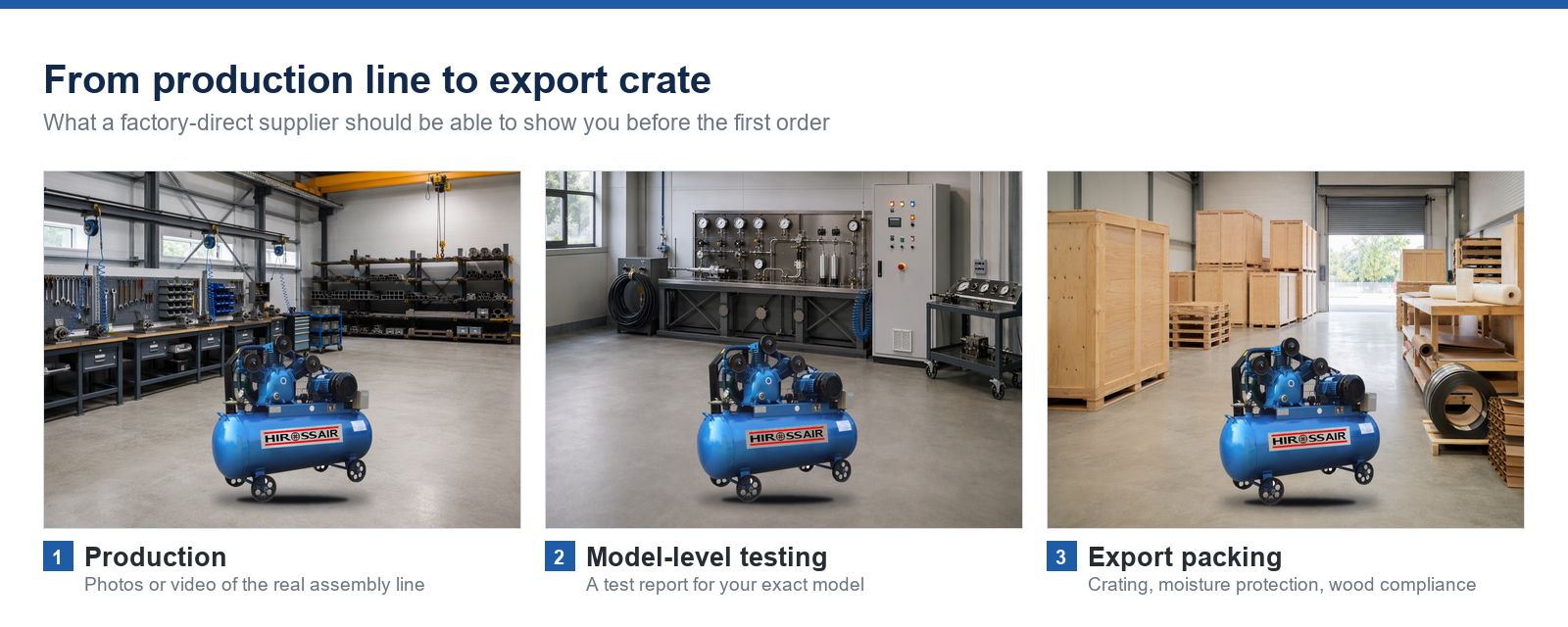
- Production evidence — photos or video of the actual assembly line for your model, not a showroom.
- Model-level test data — a test report for the model you are buying, not a generic performance curve for the series.
- Component traceability — who makes the motor, valves, controls, and receiver, and whether those brands are stated in the contract.
- Modification capability — can they build to your voltage, tank size, paint colour, and nameplate?
- Spare parts commitment — a parts list with prices, and a stated availability window.
The technical questions that decide whether a piston compressor fits
Reciprocating compressors are designed around intermittent duty. Published duty-cycle figures vary by design and manufacturer — Champion Pneumatic lists 70–80% for reciprocating units against 100% for rotary compressors, while JM Industrial puts typical piston duty cycles at 50–70%. Whichever number your supplier quotes, the buyer's job is to match it to how the machine will actually run in the destination market.
Four specifications deserve scrutiny in the quotation:
Flow rating basis. Ask whether the quoted flow is measured according to ISO 1217, Displacement compressors — Acceptance tests, which specifies methods for acceptance tests of volume rate of flow and power requirements. A flow figure without a stated test basis is not comparable between suppliers, and the difference is often where a "cheap" quote is hiding.
Pressure and receiver sizing. Piston compressors deliver air in pulses, so receiver volume and piping are part of the system design. Sizing the tank for the tool with the highest instantaneous demand is what prevents short-cycling.
Oil-free or lubricated. If the air contacts product — food, pharmaceutical, electronics, packaging — specify oil-free, and ask how the design keeps crankcase oil out of the air stream. Oil-free double-acting designs separate the crankcase from the cylinder mechanically, rather than filtering oil out downstream.
Motor and electrical standard. Voltage, frequency, phase, insulation class, and protection rating must match the destination grid. A 380 V/50 Hz machine supplied into a 460 V/60 Hz market is a warranty dispute waiting to happen.
Internal link placeholder: [Why Piston Air Compressors Are Still Popular in Industrial Applications]
Compliance depends on the destination market
This is the part buyers underestimate most. The same machine does not ship into every market with the same paperwork.
European Union. Two separate frameworks usually apply to a compressor package.
- Machinery: Regulation (EU) 2023/1230 replaces the Machinery Directive 2006/42/EC and applies from 20 January 2027. CE documentation, a technical file, and a risk assessment are the manufacturer's responsibility — confirm which version of the framework your supplier is working to if delivery lands near that date.
- Pressure equipment: Directive 2014/68/EU (PED) covers the design, manufacture, and conformity assessment of pressure equipment with a maximum allowable pressure greater than 0.5 bar. The conformity assessment route scales with volume and pressure, so receiver tanks and any pressure-bearing assembly need to be assessed on their own terms — not simply assumed because the compressor carries a CE mark.
Other markets. Requirements for pressure vessels and electrical equipment vary by country and are typically administered by a national authority or an accredited body. Ask your supplier which declarations and test reports they can issue for your specific destination, and confirm them with a notified body or your customs broker rather than taking a catalogue claim at face value.
Documentation package to write into the contract:
- Model-level performance test report
- Declaration of conformity / compliance documents for the destination market
- Wiring diagram and electrical data sheet
- Illustrated parts list with part numbers
- Operation and maintenance manual in the destination language
- Packing list, certificate of origin, and commercial invoice matching the HS classification
Logistics, terms, and classification
Classification. Air compressors sit under HS heading 8414.80 — other air or gas compressors — at the 6-digit international level. National subheadings and duty rates differ: in the U.S. HTS, for example, stationary reciprocating units fall in the 8414.80.16 group. Always confirm the exact subheading and current duty rate with your customs broker before signing, because reclassification after shipment is expensive.
Trade terms. Incoterms 2020 defines 11 internationally recognized rules that set out buyer and seller responsibilities, including who clears export and import and where risk transfers. Most first orders ship FOB or CIF; distributors with their own import capability sometimes negotiate EXW. Be explicit about port of loading, whether freight is included, and who bears destination charges — ambiguity here is the most common source of invoice disputes.
Packing for sea freight. Piston compressors are heavy, oil-lubricated machines travelling through humid conditions. Confirm moisture protection inside the crate, and confirm that any wooden packaging meets the destination's wood-packaging plant-health requirements — verify this with your forwarder, as rules change.
Spares with the first order. The cheapest time to buy piston rings, valve plates, gaskets, and filters is bundled with the machine, not as an air-freight emergency six months later.
What actually drives the price when you buy direct
For context on the market you are buying into: published 2026 estimates of global air compressor market value range from roughly USD 20 billion to USD 30.5 billion, with CAGRs quoted between 4.8% and 6.8% depending on the report. The spread reflects different scope definitions — some count only industrial units, others include portable and reciprocating segments — so treat any single number as indicative rather than precise.
Inside a quotation, cost sits in a small number of places: the motor, the compression element and valves, the receiver and controls, the paint and enclosure, and the freight. When two factories quote a wide gap on the same specification, the difference is usually one of these — a lighter-gauge receiver, a lower-efficiency motor, unbranded valves, or thinner packaging. Ask for a component-level breakdown rather than a lump sum.
Two protections are worth the cost on a first order:
- Pre-shipment inspection by a third party, with the report issued against your specification, not the supplier's.
- Staged payment — deposit against the order, balance against a copy of the bill of lading and inspection report.
Sourcing checklist: eight questions to ask before you order
FAQ
Can we buy piston compressors under our own brand? Private-label and OEM programs are common, but scope varies by supplier and usually depends on order volume and whether new tooling (nameplates, labels, paint) is required. Ask for the minimum order quantity that applies to your branding request.
Does a factory-direct compressor come with CE documentation? Only if the manufacturer has carried out the applicable conformity assessment for your destination. Note that the EU machinery framework changes on 20 January 2027 with Regulation (EU) 2023/1230, and that pressure equipment such as receiver tanks is assessed separately under Directive 2014/68/EU when the maximum allowable pressure exceeds 0.5 bar.
What is the typical minimum order quantity and lead time? Both are supplier-specific. [Insert MOQ: ____]. [Insert standard lead time: ____ weeks after deposit and drawing approval].
What spare parts should we stock with the first order? Piston rings, valve plates and springs, gaskets, air filters, belts where applicable, and a set of consumables matching the maintenance schedule in the manual.
Is a factory-direct price always lower? Not necessarily on a like-for-like specification. Direct supply removes intermediary margin, but it also removes the intermediary's inspection layer. Compare component-level specifications, warranty terms, and documentation scope — not headline price alone.
Table of Contents
- What "factory direct" should actually mean
- The technical questions that decide whether a piston compressor fits
- Compliance depends on the destination market
- Logistics, terms, and classification
- What actually drives the price when you buy direct
- Sourcing checklist: eight questions to ask before you order
- FAQ