 EN

Moisture damage rarely announces itself. It shows up as rust blooming on stored steel, cardboard boxes going soft in a warehouse, mold spreading behind a finished wall, or a batch of lithium cells that fails inspection two weeks after production. By the time anyone notices, the money has already been lost — and it was never spent on a dehumidifier.
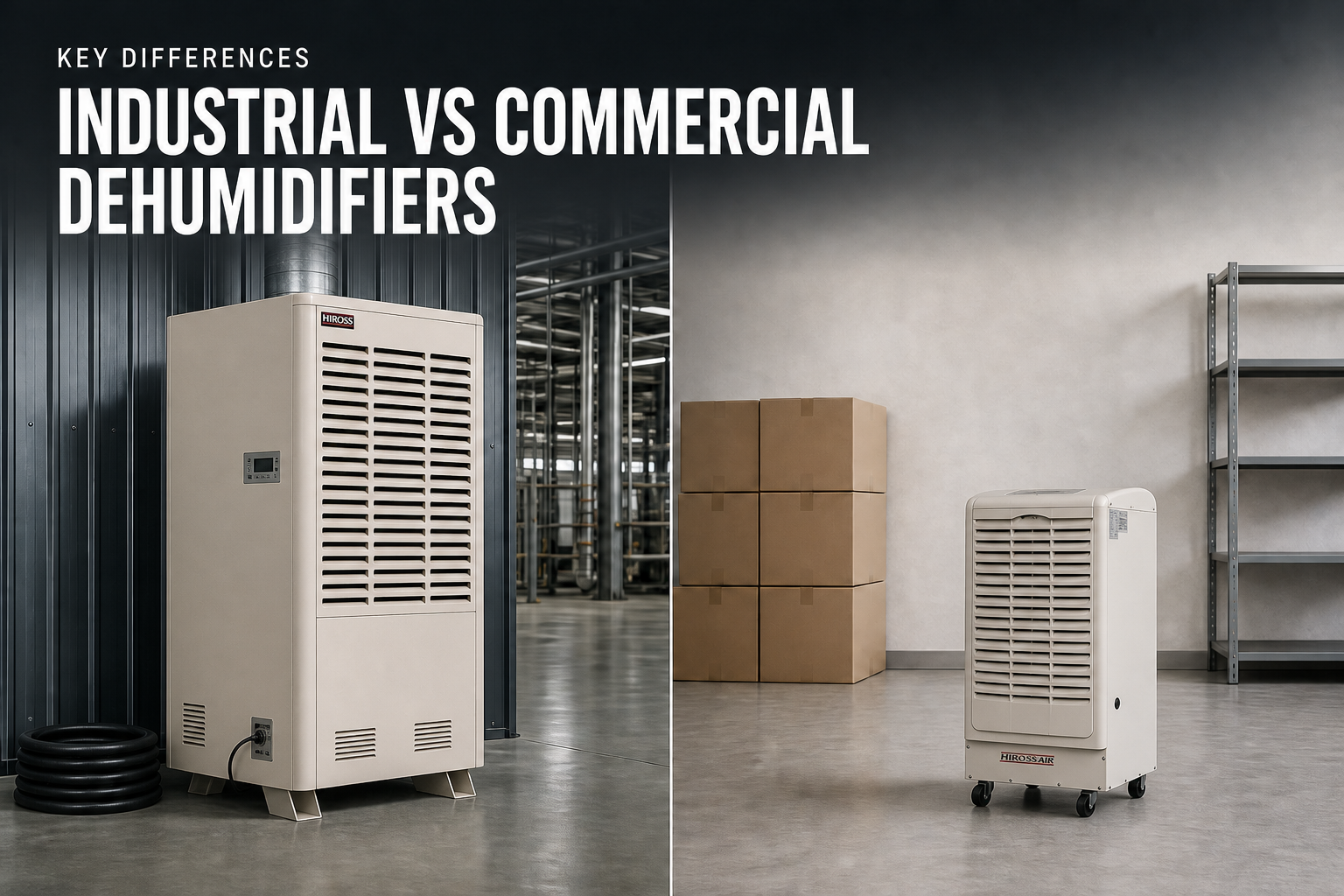
That is why so many buyers end up asking the same question: do I need an industrial dehumidifier or a commercial one? The two terms are used almost interchangeably in sales copy, but they describe different machines — different duty cycles, different control precision, and often a five-fold gap in price.
This guide breaks down the key differences so you can size the right unit the first time.
The Short Answer
- Commercial dehumidifiers are built for spaces where people work and inventory sits: offices, retail floors, gyms, basements, small warehouses. Moderate duty, moderate precision, portable.
- Industrial dehumidifiers are built for environments where humidity is a process variable: food processing, pharmaceutical production, lithium battery dry rooms, cold storage, coating lines. Heavy duty, tight precision, frequently ducted or tied into a plant HVAC system.
The dividing line is not the size of the room. It is whether humidity affects your product or your process. A 500 m² office and a 500 m² cleanroom are the same footprint and completely different problems.
Side-by-Side: The Key Differences
Numbers are indicative ranges from published buying guides, not a specification for any single model. Always compare units at the same test conditions — more on that below.
Difference 1: Capacity and Scale
Capacity is the first thing buyers compare, and the first thing they misread.
Commercial units are usually rated in litres or pints per day and sized to a room volume: a 90 L/day model covers roughly 90–150 m³, a 138 L/day model roughly 130–180 m³, with humidity held anywhere in a 40–90% RH band. Industrial units are frequently rated in litres per hour with an airflow figure attached — 7, 10, 16 or 20 L/h paired with 2,000 to 5,600 m³/h of circulation — because in a production hall, moisture load is generated continuously and air changes matter as much as chamber volume.
The practical consequence: you cannot pick a dehumidifier by floor area alone. You need the moisture load (process evaporation, infiltration, door traffic, people, floor washdown) plus a target air-change rate — around 4–5 ACH for typical commercial spaces, higher where moisture is actively released.
Difference 2: Build Quality and Duty Cycle
A commercial unit might run eight hours a day through a humid season and sit idle the rest of the year. An industrial unit in a food plant may run 8,000 hours a year with washdown cycles, vibration and dust.
That gap shows up in materials and design: commercial housings lean toward plastic or light-gauge steel with an emphasis on portability and appearance, while industrial cabinets are heavy-gauge steel built for harsh environments and long service life. Industrial designs also assume maintenance — accessible coils, filters and blowers that a plant technician can service on schedule rather than a sealed appliance that is replaced when it fails.
Difference 3: Humidity Control Precision
This is the difference that most often decides a purchase, and the one most often ignored.
For a basement or a break room, a ±10% RH swing is irrelevant. For a pharmaceutical suite or a food processing line, that same swing can spoil a batch. Premium commercial-grade units use precision sensors that can hold a setpoint within ±1–2% RH; industrial systems are specified differently again — not as "comfort range" but as an absolute process tolerance.
Two real examples make the point. Catalog precision for industrial dehumidifiers is commonly quoted around ±5% RH. Lithium battery dry rooms, by contrast, are specified below 1% RH, with dew points from −40°C down to −60°C. Those are not the same class of machine, and the control architecture — sensor placement, redundancy, reaction speed, integration with a building management system — is what separates them.
Difference 4: The Operating Temperature Window
Technology choice matters as much as size.
Refrigerant (condensation) dehumidifiers work by cooling air below its dew point, so they are effective in moderate conditions — generally at or above 10°C indoor air temperature — and lose capacity as it gets colder. Below that, coils frost, airflow blocks and the unit cycles off. Low-grain-refrigerant (LGR) designs with hot-gas bypass push the limit down to roughly 1°C.
Desiccant dehumidifiers use a rotor loaded with silica gel or molecular sieve to adsorb moisture instead of chilling it, which is why they operate across roughly 1–40°C ambient and are the practical choice for cold rooms, freezer areas and low-dew-point processes. They can also reach dew points of 50°F (10°C) or lower — territory refrigerant systems cannot hold efficiently — and because the moisture never wets a cold coil, frosting is not a failure mode.
The trade-off runs the other way in hot, humid, high-load spaces: desiccant units are not the right tool for a pool hall or a laundry, where refrigerant capacity per dollar wins.
Difference 5: The True Cost of Ownership
Purchase price is the least interesting number.
On published 2025 market data, commercial units run roughly $300–$1,500 and industrial units roughly $1,500–$5,000, with ducted or engineered systems above that. But industrial machines typically post a higher energy efficiency ratio (EER ≈ 3.2–4.5 versus ≈ 2.5–3.5), and a 24/7 duty cycle turns a small efficiency gap into a large annual electricity bill. Modern desiccant systems can also recover the latent heat of adsorption and reuse it for regeneration, cutting or eliminating reheat energy.
So the honest comparison is: purchase price + annual kWh + maintenance + the cost of one spoiled batch. In process industries, that last line usually dominates.
Which One Do You Actually Need?
Choose commercial if:
- Humidity affects comfort, appearance or stored goods — not a production step
- The space is under roughly 50 m²–300 m³ and intermittently occupied
- Short operating seasons, and portability or simple plug-in installation matters
- Budget sensitivity outweighs 24/7 reliability
Choose industrial if:
- A product spec, standard or customer audit sets a humidity limit
- The room runs continuously, or sits in a cold chain near or below freezing
- Air has to be ducted, distributed or balanced against a plant HVAC system
- Downtime has a production cost, not just a comfort cost
When the load is large and the target is tight, splitting capacity across two medium units often beats one oversized machine: better air distribution, and partial backup if one unit is serviced.
FAQ
Can I use an industrial dehumidifier in a commercial space? Yes — it will simply be oversized and overbuilt for the job, which usually means higher purchase cost and unnecessary noise. Industrial units are also louder than domestic-grade machines, though modern designs are often around 60 dB.
Why does my dehumidifier's rated capacity never match reality? Because capacity is measured under specific test conditions. In the US market, capacity is measured on the ANSI/AHAM DH-1 procedure, referenced by the DOE test appendix for dehumidifiers; AHAM-rated capacity and saturation capacity are different figures. Cold rooms and low-humidity targets will always under-deliver against a warm, humid test rating.
Is a desiccant or refrigerant unit better for cold storage? Desiccant. Refrigerant units need air warm enough to condense onto the coil; desiccant rotors work across roughly 1–40°C and are the standard choice where dew point, not temperature, is the constraint.
How precise can humidity control get? Commercially, ±1–2% RH is achievable with precision sensors on premium units. Process-grade industrial systems go further, down to sub-1% RH and dew points of −40°C or lower for battery and pharmaceutical dry rooms.
The Bottom Line
Industrial and commercial dehumidifiers differ in capacity, cabinet construction, control precision, operating temperature window and cost structure — but the decision reduces to one question: is humidity a comfort issue or a production spec? Answer that, calculate the real moisture load, and the machine class chooses itself.
[CTA placeholder — insert company/product link] Sizing a dehumidification system for a workshop, warehouse or dry room? Our engineers can run a humidity load calculation and recommend the right capacity and technology — including desiccant or low-dew-point options for cold and process environments. Request a free load assessment.
Sources
- Industrial vs. Commercial Dehumidifiers: What's the Difference? — Ant Air System (Aug 2025)
- Residential vs Commercial Dehumidifier Buying Guide — Scitek Global (Sep 2026)
- Refrigerant-Based vs. Desiccant Dehumidification Systems — dehumidifiers.com
- Dehumidifier Operating Temperatures — Sylvane
- Desiccant vs Compressor Dehumidifiers — EcoAir
- ANSI/AHAM DH-1-2008 — Dehumidifiers (ANSI Webstore)
- Test Procedure for Dehumidifiers — U.S. Department of Energy
- Essential for Safe Lithium Battery Manufacturing — C DI HVAC
Table of Contents
- The Short Answer
- Side-by-Side: The Key Differences
- Difference 1: Capacity and Scale
- Difference 2: Build Quality and Duty Cycle
- Difference 3: Humidity Control Precision
- Difference 4: The Operating Temperature Window
- Difference 5: The True Cost of Ownership
- Which One Do You Actually Need?
- FAQ
- The Bottom Line