 EN

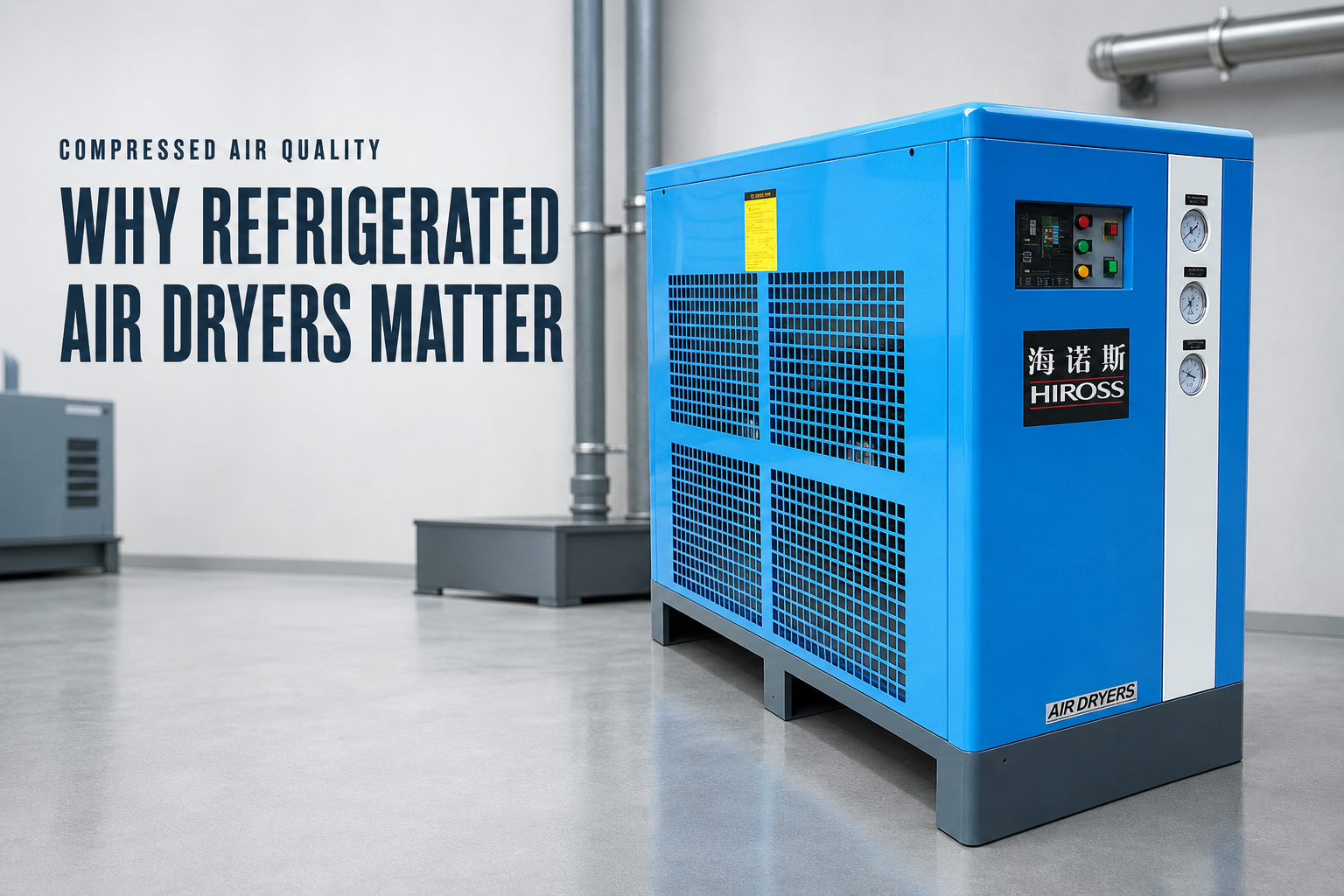
A compressed air system does not distribute air. It distributes air plus water — a lot of water — and the water is invisible until it is not.
Take a published worked example: a 45 kW rotary screw compressor delivering 7 m³/min at 7 bar, drawing ambient air at 20 °C and 50% relative humidity. That intake carries 85,680 grams of water vapour per day. After the after-cooler cools the air to 40 °C, about 21 litres drop out as liquid condensate. But the compressed air leaving the compressor is still at 100% relative humidity — saturated. As it travels through the piping and cools to ambient temperature, another 42.9 litres per day condenses inside the system.
That is 43 litres of water per day finding its way into your tools, valves, cylinders and end products. A condensate trap will not stop it — a trap removes liquid water, not water vapour. Only a dryer removes vapour. That is the entire case for refrigerated air dryers.
What a Refrigerated Air Dryer Actually Does
A refrigerated dryer works on a simple physical principle: cool the air below its dew point and the water vapour condenses out.
Compressed air enters a heat exchanger and is chilled by a refrigerant circuit to roughly 3–7 °C. At those temperatures air can hold very little moisture — at 4 °C, saturation is about 6.25 g/m³, against 51 g/m³ at 40 °C. The surplus condenses, is separated, and leaves through a drain. The air is then re-heated on the way out, typically to around 30 °C, dropping its relative humidity to roughly 21% and stopping condensation on downstream pipework.
In the same worked example, adding a refrigerated dryer to the system removed 56 litres of water per day inside the dryer — on top of the 21 litres already taken out at the after-cooler. Total water removed: about 77 litres a day, from one mid-size compressor.
The key property to remember: as long as the compressed air stays above the dryer's dew point, no further condensate forms. That is what "dry air" means in practice — not air with no water in it, but air that can no longer rain inside your plant.
Why This Matters More Than Most Plants Realise
1. Corrosion from the inside out. Water pooling in receivers, headers and drop legs corrodes steel pipework and vessels. Corrosion products then travel downstream as particulate contamination, so a moisture problem quietly becomes a filtration problem too.
2. Frozen and seized pneumatic controls. Where lines run outdoors, through cold rooms or in unheated buildings, residual moisture freezes at valves and instrument air lines. Failures appear as erratic actuators and stuck valves — rarely as an obvious "water" fault.
3. Product and process contamination. In food, pharmaceutical, electronics and packaging applications, moisture and the microbial growth it supports are not a maintenance issue but a quality and compliance issue. This is why those industries work to defined air purity classes rather than to "looks dry enough".
4. Accelerated wear in tools and cylinders. Rust inside cylinders and valves shortens service life, and spray-painting finish defects are frequently traced to the air supply rather than the coating.
5. Maintenance that keeps recurring. Condensate at the point of use shows up as repeated filter changes, blocked drains and unexplained quality defects, consuming maintenance hours without being solved at the source.
Where a Refrigerated Dryer Sits in ISO 8573-1
Compressed air quality is defined internationally by ISO 8573-1:2010, which classifies three contaminants — particles, water and oil — using a three-part code: [Particles : Water : Oil]. The water class is expressed as a pressure dew point.
A refrigerated dryer is the workhorse of Classes 4–5. A unit holding a 3 °C pressure dew point meets Class 4; running at 4 °C it sits in Class 5. Published industry guidance for general industrial applications puts the practical target for most refrigerated dryers at a pressure dew point between 3 °C and 10 °C, with many manufacturers quoting something in the 34–40 °F (roughly 1–4 °C) band at rated conditions.
Two implications follow. If your process needs Class 2 or better (≤ −40 °C), a refrigerated dryer alone will not get you there — that is desiccant territory. And do not buy a lower dew point than the application needs: purity costs energy, paid for on every operating hour. Published application examples include food and beverage and pharmaceuticals at 1:2:1, textile machinery at 4:4:3 and general pneumatic tools at 3:4:4.
Refrigerated vs Desiccant: Where the Line Falls
The rule: refrigerated dryers protect equipment and product quality from condensation in normal plant conditions; desiccant dryers guarantee dryness in cold environments or to a purity class where condensation is not an option.
Reading a Refrigerated Dryer Datasheet
Dew point is one line on the sheet. The rest decides whether the dryer actually performs in your plant.
- Rated inlet conditions. Capacity is quoted at a specific inlet air temperature, ambient temperature and pressure — commonly around 35–40 °C inlet. A dryer sized at 25 °C ambient will be undersized in a hot compressor room.
- Ambient temperature limit. Published Hiross refrigerated dryer data lists a maximum ambient of 40 °C, along with a working pressure range of 0.4–1.0 MPa and pressure loss of ≤0.02 MPa. Confirm these against your actual summer conditions, not your annual average.
- Pressure dew point, not atmospheric. Dryer performance is stated as pressure dew point. Atmospheric dew point is a different number — a well-known source of specification confusion.
- Pressure loss. Pressure drop across the dryer is energy you pay for permanently. Low-pressure-loss models exist precisely because this cost recurs on every operating hour.
- Correction factors. Dryer capacity must be corrected for inlet temperature, ambient temperature and working pressure. A dryer selected on nominal m³/min alone is a dryer selected by accident.
- Cooling method. Air-cooled units suit most plants; water-cooled models suit high ambient temperatures or large capacities.
- Fixed vs variable frequency. Variable-frequency drying follows changing load instead of cycling on and off — worth it where air demand fluctuates through the shift.
Three Sizing Mistakes Worth Avoiding
Sizing on compressor nameplate capacity. Size on actual free air delivery (FAD) and actual site inlet temperature, then apply a margin — compressor and dryer ratings use different reference conditions.
Forgetting summer. Dryer capacity falls as ambient temperature rises, exactly when moisture load peaks. A dryer rated to its limit in July is undersized for the year.
Treating the dryer as the whole solution. A dryer removes vapour; it still depends on maintained drains and separators, and on filtration for particles and oil. Filters are commonly replaced every 12 months or after roughly 4,000–8,000 operating hours.
One more reminder from the example above: condensate forms at the coldest point in the line. If a section of pipework runs colder than your dryer's dew point — an outdoor run, a cold store, an unheated extension — condensation will occur there regardless of how well the dryer performs at its outlet.
FAQ
Do I need a dryer if I already have condensate traps and drains? Yes. Traps and drains remove liquid water only; water vapour passes straight through them and condenses further downstream.
What dew point does a refrigerated dryer reach? Typically 3–10 °C pressure dew point, with most manufacturers quoting a figure around 1–4 °C at rated conditions. That corresponds to ISO 8573-1 water Class 4–5.
Can a refrigerated dryer replace a desiccant dryer? No. If your requirement is ISO Class 2 (≤ −40 °C) or the line runs at or below freezing, you need desiccant drying. Refrigerated dryers serve general industrial applications.
Will a dryer fix moisture problems at the point of use? It fixes the source. Persistent point-of-use moisture usually points to a failed drain, or to air cooling below the dryer's dew point somewhere in the pipework.
How much water are we really talking about? In the published 45 kW / 7 m³/min example at 20 °C and 50% RH: about 21 litres per day at the after-cooler, 43 litres per day in the piping, and 56 litres per day removed by the dryer — roughly 77 litres a day in total. At higher ambient temperature and humidity, more.
The Bottom Line
A refrigerated air dryer is not an accessory — it is the component that turns wet, saturated compressed air into a usable utility. Without it, the water your compressor produces by physical necessity ends up in your pipework, tools and product. Size it on real site conditions, match the dew point to your ISO 8573-1 target, and maintain the drains and filters.
[CTA placeholder — insert company/product link] Refrigerated dryer selection starts with real inlet conditions. Our range covers air-cooled and water-cooled units, fixed- and variable-frequency models, and low-pressure-loss designs for plants where pressure drop is a permanent cost. Send us your compressor data, ambient conditions and air purity target, and we will size the dryer to match.
Sources
- Water in Compressed Air Calculations — Air Compressor Guide (worked 45 kW / 7 m³/min example)
- Air quality standards (ISO 8573-1) — Pneumatech
- Understanding ISO classes for compressed air quality — Atlas Copco
- Air dryer dew point settings in hot weather — ABAC
- Pressure dew point explained — aircompressors.com
- Refrigerated vs desiccant air dryer — Compressed Air Ohio
- Problems with compressed air condensation — Atlas Copco
- Refrigerated Air Dryer — HIROSS product range