 EN

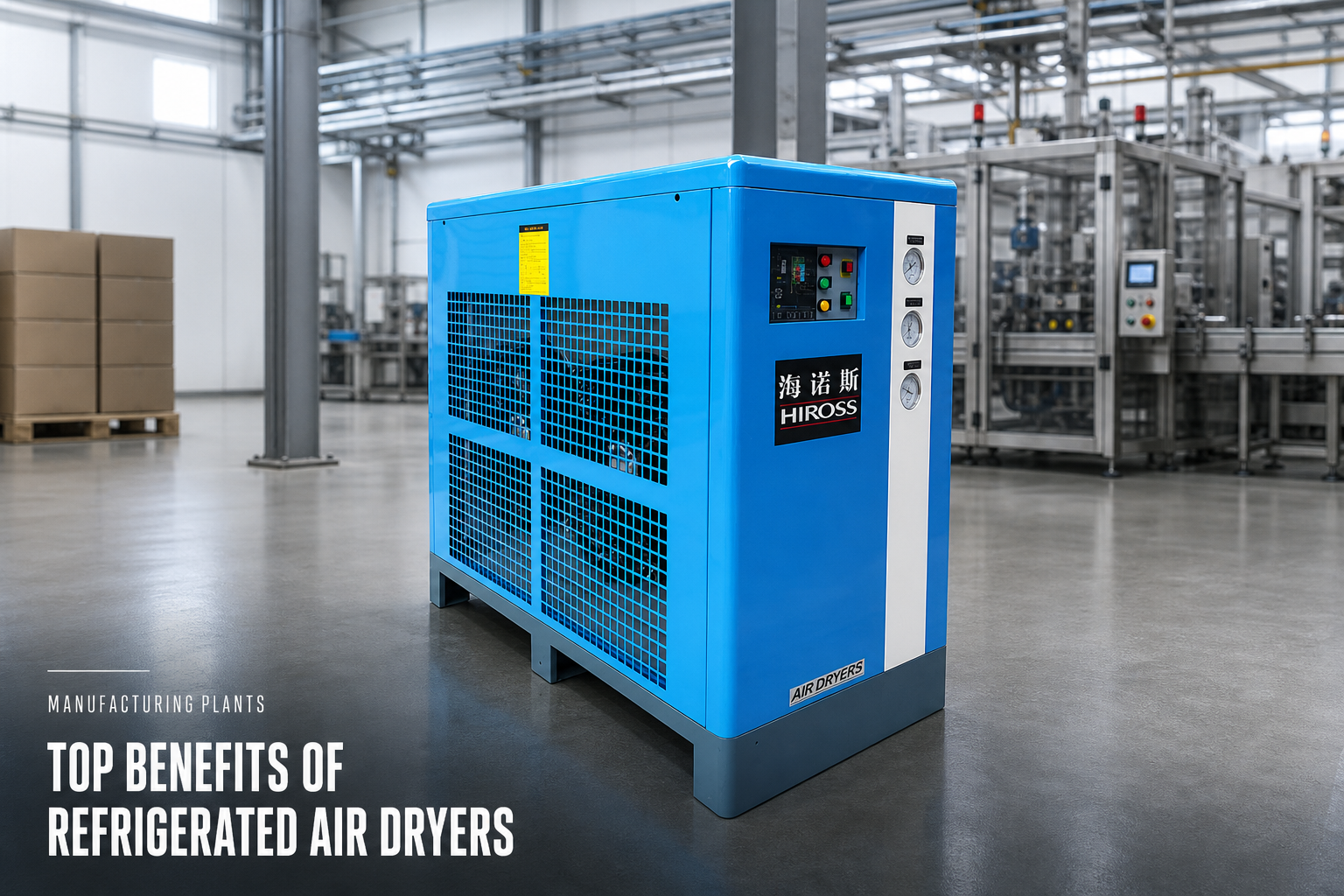
Compressed air is not a cheap utility. Systems across industry account for roughly 10% of total industrial electricity use, which is why every component in the chain gets scrutinised at budget time — including the dryer.
For most manufacturing plants, the business case for a refrigerated air dryer is not a debate about dew point theory. It is about four things a plant manager is measured on: energy cost per unit produced, uptime, quality rejects, and maintenance hours. Here is what a refrigerated dryer actually contributes to each.
Benefit 1: Energy Cost That Stays Proportional to Production
A fully loaded refrigerated dryer is one of the cheapest treatment steps in the system. Published data on dryer-specific power puts it at 0.6–0.8 kW per 100 scfm, or roughly 3–4% of total compressed air system power.
The catch is what happens at partial load — the normal state of most plants. A non-cycling dryer with hot-gas bypass keeps consuming near-full-load power no matter how little air passes through it. Measured data shows specific power rising from 0.7 kW/100 scfm at full load to as high as 5.36 kW/100 scfm at 10% loading. In a published example, a non-cycling dryer running at 22.5% of its rated flow consumed about 81% of full-load power — 4.94 kW, or 11% of the compressor's power draw. Substituting a cycling, variable-speed or digital-scroll dryer brought that back to 2–4% of compressor power.
For a plant running two shifts with weekend shutdowns, that difference is the single largest controllable cost inside the dryer.
Three further effects are worth knowing:
- Inlet temperature. Cooling the dryer inlet from 100 °F to 80 °F reduces the heat load by about 38%, and dryer energy consumption falls in proportion.
- Pressure drop. Compressors consume roughly 1% more power for every 2 psig of additional discharge pressure — so a dryer with 2.1 psid differential rather than 4.8 psid cuts compressor energy by around 1.3% at full flow. Low-pressure-loss designs pay for themselves continuously.
- Load matching. Dryers that cycle or modulate down with the load only deliver their saving over the upper half of the range; below about 50% load, VSD designs revert to hot-gas bypass behaviour. Sizing and control strategy decide whether the saving is real.
Benefit 2: No Purge Air Is Taken From Production
Heatless desiccant dryers regenerate by forcing dry compressed air through the saturated bed and venting it to atmosphere. That purge consumes 15–20% of the dryer's rated capacity — air your compressors produced with real electricity and then throw away.
It gets worse at light load, because purge flow is fixed by the dryer's rating rather than by actual demand. In a published example, a 500 cfm dryer on a system averaging 150 cfm consumed 75–100 cfm for purge — 50–66% of all the air the running compressor produced, at a cost reaching $19,000 per year in purge alone at 10 cents per kWh.
A refrigerated dryer has no regeneration cycle and no purge loss. Its own electrical draw is small: published comparisons put desiccant units at roughly 2–3 kW per 100 cfm of rating against about 0.8 kW per 100 cfm for refrigerated dryers — close to four times the energy for the same nominal capacity. Industry guidance is blunt about the conclusion: for more than 90% of compressed air systems, refrigerated dryers are the more economical and entirely suitable choice.
Benefit 3: Reliability, Uptime and Longer Tool Life
Water in compressed air does not stay where it forms. It condenses in pipework, receivers and drop legs, corrodes steel from the inside, and carries rust, oil and pipe debris downstream into tools and production machinery.
The shop-floor consequences are familiar: cylinders and valves rusting internally, erratic actuators, tools failing early on a schedule nobody can explain, and valves or instrument air going out of service wherever water freezes in exposed lines.
Because a refrigerated dryer holds a pressure dew point in the proven 39–45 °F (3–7 °C) band, downstream air stays above its condensation threshold under normal plant conditions. That is what turns "air supply" from an intermittent reliability risk into a stable utility.
Benefit 4: Consistent Product Quality and Fewer Rejects
Moisture shows up in output quality long before it shows up in maintenance records — surface finish defects in spray painting, contamination in packaging, wet spots in food handling, and defects in any process where the air touches the product directly. Plants in food, beverage and pharmaceutical production work to defined ISO 8573-1 purity classes for exactly this reason, and the water class is set by the dryer.
A refrigerated dryer reaches ISO 8573-1 water Class 4–5, which covers general industrial manufacturing, metal fabrication, packaging, textiles and pneumatic tooling. If your process spec is Class 2 or better, refrigerated drying is not the answer — but for most manufacturing operations it is sufficient and the most cost-effective route.
Benefit 5: A Smaller Maintenance Burden — and a Lower Installed Cost
Desiccant dryers buy their low dew point with parts: desiccant media, switching valves, heaters or blowers, and the service labour that goes with them — which is why they cost more to buy and to run than refrigerated dryers. Refrigerated units are physically simpler: a sealed refrigeration circuit, a heat exchanger and a drain, with no cooling water supply, regeneration hardware or specialist commissioning.
The maintenance that remains is predictable:
- Filters and separators replaced every 12 months or roughly 4,000–8,000 operating hours, more often in dirty environments.
- Condensate drains checked and cleaned on a routine round.
- Dryer pressure differential watched as an early indicator of fouling.
Where demand varies heavily by shift, two staged medium units often beat one large dryer — and provide partial backup during service. Where demand is steady, a non-cycling unit is the simplest and cheapest to own.
Benefit 6: Right-Sized Drying Without Over-Drying
Drying beyond the requirement is a permanent, invisible cost. Every degree of additional dryness is paid for on every operating hour, and oversized heatless desiccant dryers carry a specific penalty: more purge air, more desiccant, larger filters.
Refrigerated drying matches the dryer to what the plant actually needs, and reserves low-dew-point drying for the points of use that genuinely require it — instead of conditioning the whole plant supply to a specification only 5% of it needs.
Where Refrigerated Drying Stops Being the Answer
Being clear about the limits is part of choosing well. A refrigerated dryer is the wrong tool when:
- Piping runs through freezing areas or outdoors in cold months, so vapour condenses or freezes downstream of the dryer.
- A process genuinely specifies a low dew point that only desiccant drying can hold.
- The compressor room is so hot or dirty that a refrigerated dryer would need excessive maintenance or heavy oversizing.
In those cases, the correct configuration is usually a refrigerated dryer for the main plant supply plus point-of-use desiccant drying for the few consumers that need it — not a desiccant dryer conditioning the whole system.
How to Capture These Benefits in Practice
- Size on real conditions. Use actual free air delivery, actual inlet temperature and actual summer ambient — then apply margin. Dryer capacity falls as ambient rises.
- Match the control type to the load profile. Cycling, VSD or digital scroll where demand varies; non-cycling where it is steady.
- Treat pressure drop as a permanent cost. Low-pressure-loss designs reduce compressor power on every operating hour.
- Manage condensate properly. A dryer removes vapour; drains and separators still have to remove the liquid.
- Keep filtration in the plan. Particles and oil are separate contaminant classes; the dryer only addresses water.
- Set a dew point target deliberately. Dry to the class your process requires, not to a habit.
FAQ
Is a refrigerated air dryer enough for a general manufacturing plant? For most plants, yes. Refrigerated dryers hold a 39–45 °F (3–7 °C) pressure dew point, covering ISO 8573-1 water Class 4–5, which suits general industrial air, metal fabrication, packaging and pneumatic tooling.
How much energy does a refrigerated dryer use? About 0.6–0.8 kW per 100 scfm at full load — roughly 3–4% of total compressed air system power. At partial load, non-cycling designs lose that efficiency advantage; cycling and variable-speed designs recover most of it.
Why not just buy the dryer with the lowest dew point? Because dryness costs energy. Purity beyond the requirement is paid for on every operating hour, and oversized heatless desiccant dryers also consume production air as purge.
Does drying the air remove the need for filters and drains? No. Dryers, filters and drains handle three different contaminants — water vapour, particles, oil — and condensate still has to be removed by drains and separators.
The Bottom Line
A refrigerated air dryer earns its place in a manufacturing plant on cost and reliability, not specification bravado: no purge loss, low specific power, a dew point that protects equipment in normal plant conditions, and a maintenance load measured in filter changes rather than service contracts. Size it against real conditions, match the control type to your load profile, and keep pressure drop low.
[CTA placeholder — insert company/product link] Refrigerated dryer selection starts with your actual air demand, inlet temperature and ambient conditions. Our range covers air-cooled and water-cooled units, fixed- and variable-frequency models, and low-pressure-loss designs for plants where pressure drop is a permanent cost. Send us your compressor data and we will size the dryer to match.
Sources
- Cycling Refrigerated Air Dryers – Are Savings Significant? — Compressed Air Challenge / Air Best Practices (Ron Marshall)
- How costly is my desiccant dryer? — Pneumatic Tips
- Desiccant dryers: love 'em or leave 'em — Kaeser Talks Shop
- Desiccant Air Dryers vs. Refrigerated Air Dryers — Sullair
- Understanding ISO classes for compressed air quality — Atlas Copco
- Air quality standards (ISO 8573-1) — Pneumatech
- A review on compressed-air energy use and energy savings — ScienceDirect
- Refrigerated Air Dryer — HIROSS product range
Table of Contents
- Benefit 1: Energy Cost That Stays Proportional to Production
- Benefit 2: No Purge Air Is Taken From Production
- Benefit 3: Reliability, Uptime and Longer Tool Life
- Benefit 4: Consistent Product Quality and Fewer Rejects
- Benefit 5: A Smaller Maintenance Burden — and a Lower Installed Cost
- Benefit 6: Right-Sized Drying Without Over-Drying
- Where Refrigerated Drying Stops Being the Answer
- How to Capture These Benefits in Practice
- FAQ
- The Bottom Line