 EN

Scroll through any compressor catalogue and rotary screw units get the front page. They are quieter, they run continuously, and variable-speed drives have made them efficient. So why do piston — reciprocating — air compressors still appear in so many plants, workshops, and processing lines?
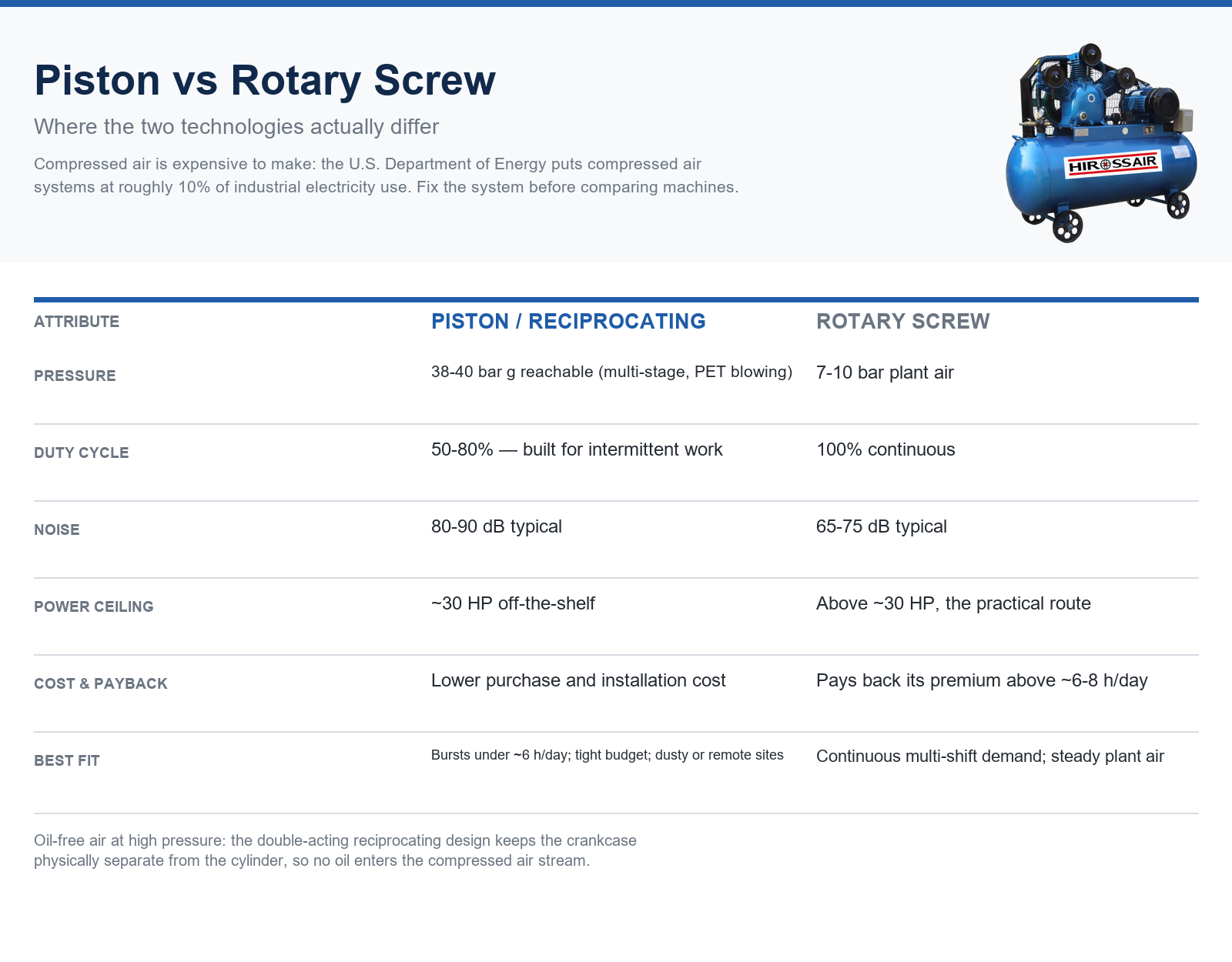
The short answer: rotary screw technology wins the middle of the market, which is steady plant air at 7–10 bar. Reciprocating technology wins almost everything else — high pressure, oil-free process air, intermittent duty, rugged environments, and small-budget installations. This article works through each of those jobs with sourced figures, then gives you a framework for choosing between the two.
How a piston compressor works — and why that still matters
A reciprocating compressor uses a crankshaft to drive one or more pistons inside cylinders. Each cycle draws in atmospheric air, compresses it, and discharges it to a receiver tank. Single-acting designs compress on one stroke; double-acting designs compress on both the up and down stroke, which raises output per cylinder for a given bore and stroke (Air Best Practices).
Two consequences follow from that design, and both shape where the technology is used:
- Air is delivered in pulses, not as a continuous stream — which makes a receiver tank and correctly sized piping part of the design, not an accessory.
- Compression happens in discrete stages, which is what makes very high pressures practical: intercooling between stages removes heat and reduces the work required for the next stage.
Seven reasons reciprocating compressors remain in industrial service
1. They reach pressures rotary screw compressors cannot
This is the clearest technical moat. PET bottle blowing — the process behind every carbonated drink bottle — typically requires 550–580 psig (38–40 bar g), at flows from 247 cfm FAD (420 m³/h) up to 3,700 cfm FAD (6,290 m³/h). The technology used most prevalently for that application is the double-acting, oil-free, water-cooled reciprocating compressor (Air Best Practices, 2011).
Where a plant air system runs at 7–10 bar, a blow-molding line runs at roughly four times that pressure. Screw technology can be staged and boosted, but in that pressure band the mainstream, proven answer is still reciprocating.
2. Oil-free air is structurally guaranteed, not filtered afterwards
In an oil-free double-acting reciprocating compressor, the crankcase is separated from the compression cylinder by a distance piece and packing. No oil travels up the piston rod, and no oil or hydrocarbons are added to the air stream (Air Best Practices, 2011). For food, pharmaceutical, PET, and electronics applications, that changes the compliance conversation: you are not removing oil downstream, you are preventing it from entering the system at all. It also extends the service life of coalescing filters installed downstream.
3. Intermittent duty is their native operating mode
Reciprocating compressors are designed for cycles where air demand comes and goes — tire shops, maintenance departments, small fabrication shops. Published duty-cycle figures vary by design and manufacturer: Champion Pneumatic lists 70–80% for reciprocating units versus 100% for rotary compressors, while JM Industrial puts typical piston duty cycles at 50–70%. Either way, the planning number sits well below continuous duty — and that is the point. These machines are built to fill a tank, rest, and start again.
4. The capital cost advantage is real at small scale
Reciprocating compressors cost less to buy and less to install. If compressed air is used a few hours a day at one or two workstations, the higher efficiency of a screw compressor never accumulates enough running hours to earn back its price premium. JM Industrial's selection guidance puts the crossover at roughly 6–8 hours of daily operation, after which the additional investment in a rotary screw machine is usually recovered through lower electricity and maintenance costs.
5. They are simple to repair — anywhere
A reciprocating compressor has a straightforward mechanical design with parts a competent maintenance team can service: oil, piston rings, intake and discharge valves, drive belts, air filters, and condensate draining (JM Industrial). In remote mines, construction sites, or export markets where a specialist airend technician may be days away, that serviceability is worth more than a theoretical efficiency gain.
6. They tolerate dirty, hot, rugged environments
The same straightforward mechanics make reciprocating units a practical fit for dusty, dirty, or demanding workplaces (Champion Pneumatic). Where a rotary screw unit needs clean cooling air and careful oil management, a piston compressor keeps working in conditions that shorten the life of more delicate machines.
7. Modern control strategies keep part-load costs in check
Reciprocating packages are no longer the simple on/off machines of thirty years ago. Step loading holds the suction valves open so compression stops while the machine keeps turning, cutting power to 8–10% of full-load brake horsepower. Variable-speed control goes further, down to roughly 4–5% of full-load BHP when unloaded — with the caveat that speed must not drop below the point where lower-end lubrication is affected (Air Best Practices, 2011).
Where reciprocating compressors are still standard practice
- PET blow molding and other high-pressure processes — 38–40 bar g
- Tire and automotive service shops — burst demand for impact wrenches, bead seating, and inflation
- Small fabrication and woodworking shops — nailers, staplers, sanders, blow-off
- Maintenance departments and general workshops — repairs, cleaning, pneumatic hand tools
- Construction and remote sites — portable, rugged, easy to service
- Booster and dedicated-process roles — feeding plant air systems, breathing air, oil-free process gas
The honest limitations
Reciprocating compressors are not a universal answer, and pretending otherwise costs buyers money:
- Not designed for continuous duty. Running one nonstop can overheat it, accelerate wear, and shorten its service life (Champion Pneumatic; JM Industrial).
- Noisy. Typical levels of 80–90 dB, comparable to a lawn mower, versus 65–75 dB for a rotary compressor — although enclosed reciprocating packages now close much of that gap.
- Pulsating flow. Pressure fluctuates between strokes, which is acceptable for general-purpose work but unsuitable for sensitive, precision processes without adequate storage.
- Limited horsepower ceiling. Most off-the-shelf reciprocating compressors top out around 30 HP; above that, rotary becomes the practical route.
- More frequent maintenance. More wear-prone contact parts means more scheduled intervention than a screw unit requires.
How to choose between piston and screw
One point outranks the compressor choice itself: compressed air is expensive to produce. The U.S. Department of Energy estimates that compressed air systems account for roughly 10% of industrial electricity consumption — about 16% of motor-system electricity. In most plants, leaks, inappropriate uses, and excessive system pressure waste more money than the difference between one compressor technology and another. Fix the system before arguing about the machine.
FAQ:
1. Why do customers choose us?
HIROSS INDUSTRY MACHINERY CO.,ltd have more than 15 years experience in designing,researching, developing and manufacturing the purify, environment friendly, energy saving equipment.Product various from compressed air dryer,dehumidifier,filter,chiller,to accessories,etc.
2.Are you a manufacturer or a trading company?
We are a professional manufacturer in Fujian, China. Has a large modern factory, with a professional design team. Provide OEM&ODM Service to our customers also.
3.Where is your factory? How can I visit it?
Our factory is located in Zhangzhou City, Fujian Province, China. We can pick you up from Xiamen Airport, about one hour from Xiamen airport to our factory. Welcome to our company!
4.What is your delivery time?
We can deliver within 15 days. For urgent orders, please contact our sales staff in advance.
5. How long is your equipment warranty period?
We can provide some spare parts of the whole machine for one year, Quality is everything. We attach great importance to quality control from the beginning to the end. Our factory has passed ISO9001 certification and CE certification.
6.How long is the service life of your equipment ?
Usually more than 10 years.
7.What are the terms of payment?
T / T, L / C, D / P, Western Union, credit card and so on. We can accept US dollar, RMB, Euro and other currencies.
8. How is your customer service?
24-hour online service. 48 hour problem solving commitment.
9.How about your after-sales service?
(1) To provide customers with online guidance for installation and debugging.
(2) Trained engineers can serve overseas.
(3) Provide global agency and after-sales service.
Table of Contents
- How a piston compressor works — and why that still matters
-
Seven reasons reciprocating compressors remain in industrial service
- 1. They reach pressures rotary screw compressors cannot
- 2. Oil-free air is structurally guaranteed, not filtered afterwards
- 3. Intermittent duty is their native operating mode
- 4. The capital cost advantage is real at small scale
- 5. They are simple to repair — anywhere
- 6. They tolerate dirty, hot, rugged environments
- 7. Modern control strategies keep part-load costs in check
- Where reciprocating compressors are still standard practice
- The honest limitations
- How to choose between piston and screw